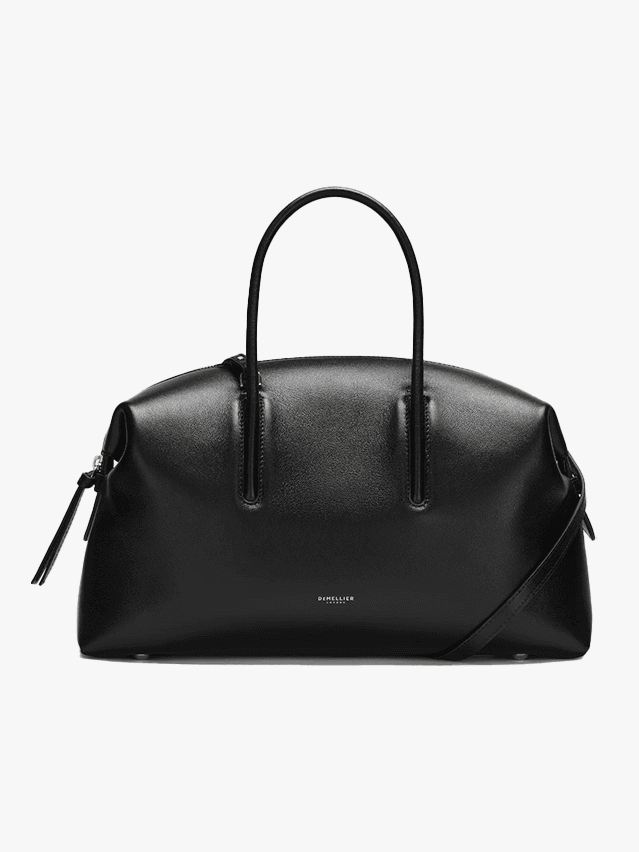
Like all codified fashion trends that reach the point of parody – a process that seems to happen alarmingly quickly these days – “quiet luxury” found itself in the proverbial bin this year along with the tomato girls, coastal grandmas and office sirens (I fondly remember a time when this sentence would’ve been nonsensical to me).
Yet, there’s something about the tenets of the stealth wealth movement that still seems to resonate with a disillusioned and overstimulated shopping public, in a way that’s allowed it to transcend the usual lifecycle of your average fashion “core”. In fact, only this week, Google reported that “quality” apparel searches are at an all-time high, with the margin between “quality” and “cheap” apparel searches being slimmer than ever.
For Mireia Llusia-Lindh, creative director and founder of DeMellier, it was a deep-rooted, and somewhat prophetic, understanding of these shifting consumer demands that inspired her to launch the brand back in 2017 – the same year that Demna was pedalling $2,000 Ikea-inspired tote bags and “millennial pink” was at the height of its success.
Featured in this article


“I felt there were many shortcuts taken in the fashion industry, and I wanted to do things differently – to design handbags that are modern and of the highest quality, ethically and sustainably made but also attainable and socially conscious,” Llusia-Lindh reflects. “For me, [building a successful brand] starts with strong values and what differentiates you from the rest. From the very beginning, we chose not to follow traditional luxury norms – male creative directors designing for women, overpriced products, or fleeting trends.”
Born in Barcelona, Llusia-Lindh attended university in Barcelona and Switzerland, and received an MBA from Harvard Business School, before working as a strategy advisor to various consumer and luxury goods firms, including Burberry and LVMH. It was in 2010 that she launched the accessories brand Milli Millu, which was then rebranded to DeMellier in 2017 – “De” originating from Mireia’s Spanish grandmother and “Mellier” coming from Mireia’s name of French descent.

In a market dominated by heritage fashion houses and iconic, 100 year-old handbag designs – and not to mention the global economic headwinds that have plagued the industry over the last five years – the speed of DeMellier’s success as a new and unknown label has been remarkable.
The Met Gala guest list-worthy roll call of A-listers that have been seen toting the brand is ever-growing: Katie Holmes, Reese Witherspoon, Emily Blunt, Kristen Bell, Jessica Alba, Renée Zellweger, Emily Ratajkowski, Gigi Hadid, Irina Shayk, Rosie Huntington-Whiteley and Elsa Hosk – to name but a few. Even the royals have given it their seal of approval (an accolade many established brands can only dream of) with the Princess of Wales, Queen Camilla and Meghan, the Duchess of Sussex, all spotted carrying one of DeMellier’s streamlined designs.
And while celebrity sightings are an important marketing tool, particularly for emerging brands hoping to cut through the noise, DeMellier’s true success arguably lies in its wooing of the average, fashion-loving consumer.
Many people – millennial-age and above – will no-doubt remember a time when their peers from middle-income families would receive Mulberry bags for their 18th birthday, or when big-name designer bags came with three rather than four-figure price tags. Now many luxury houses don’t offer anything under £1,000, which has, in turn, alienated huge swathes of the shopping public. In contrast, all of DeMellier’s bags, bar one – which are handcrafted at family-run factories in Europe – come in under £600 (the raffia bags offer the lowest price point at £265), making them, if not cheap, then at least more accessible within the luxury bag landscape.
Instagram content
“It’s so important to understand your customer. Our design process is deeply collaborative, and with a large female team of different ages, backgrounds and countries, we know that if we all love a new bag, it’s very likely to be a success, as we are customers too,” Llusia-Lindh explains. “The New York [priced at £475], which we launched in 2022, very quickly became one of our best-sellers and most iconic bags. Its belted detail felt contemporary yet timeless, and it has resonated strongly with our customers. We have since expanded the family with The Midi New York and The New York Shoulder.”
Like many other mid-priced fashion brands flourishing in the current market, DeMellier has grown a strong direct-to-consumer model via its e-commerce site, alongside an ever-growing presence on big-name multi-brand retailers (the label was picked up by Net-a-Porter in 2023). But Llusia-Lindh knows, more than most, that to achieve true longevity as a brand in a digital-first world, you need to look beyond the sales figures.
“Customers are increasingly discerning and want to understand how pieces are made, who is making them, and what a brand stands for beyond the product itself,” she explains. “For example, reaching a million life-saving vaccines and medical treatments funded through our A Bag, A Life initiative a year ago (we have now reached two million) was one of the most meaningful milestones for me.”
What’s next for DeMellier? Its very first flagship store on Sloane Square, of course, set to launch in autumn 2026. “With retail destinations on the horizon, we’re inviting our community to step deeper into our world, one built on empowerment, purpose and timeless design,” Llusia-Lindh says.
Shop Vogue’s pick of the best DeMellier bags: